Executive Summary
Role: UI/UX Designer
Timeline: 2023-2026
Platform: Electronic Municipal Market Access (EMMA®) – Municipal Securities Rulemaking Board (MSRB)
Cross-Functional Partners: BProduct Management, Engineering, Business Analysts, QA, Executive Leadership, External Vendors
Scope & Impact: Drove UX strategy across 15+ initiatives within a $6M multi-year platform modernization serving 2.1M active users, spanning workflow design, information architecture, dashboards, authentication, design systems, UX measurement, and governance.
The Challenge: Transforming a $6M Legacy Platform
EMMA is the MSRB's primary digital platform for municipal market transparency, serving a diverse audience that includes municipal issuers, financial professionals, regulators, and investors.
The organization initiated a multi-year modernization effort to replace aging technology, modernize the platform's underlying architecture, and redesign hundreds of specialized workflows.
The challenge extended beyond visual design. Modernizing the platform required addressing interconnected product, organizational, and technical challenges:
- Legacy Technology: Replacing aging technology while introducing more modern, reusable approaches to product development.
- Complex Information: Helping users navigate and understand large volumes of specialized financial data and interconnected content.
- Domain Complexity: Designing usable experiences within specialized business, regulatory, and technical constraints.
- UX Maturity: Establishing more consistent UX practices, standards, documentation, measurement, and governance as the organization moved toward product-based delivery.
The result was a modernization effort where UX needed to operate at multiple levels—from individual workflows and interfaces to the systems and practices supporting the product as a whole.
Understanding the System Behind the Interface
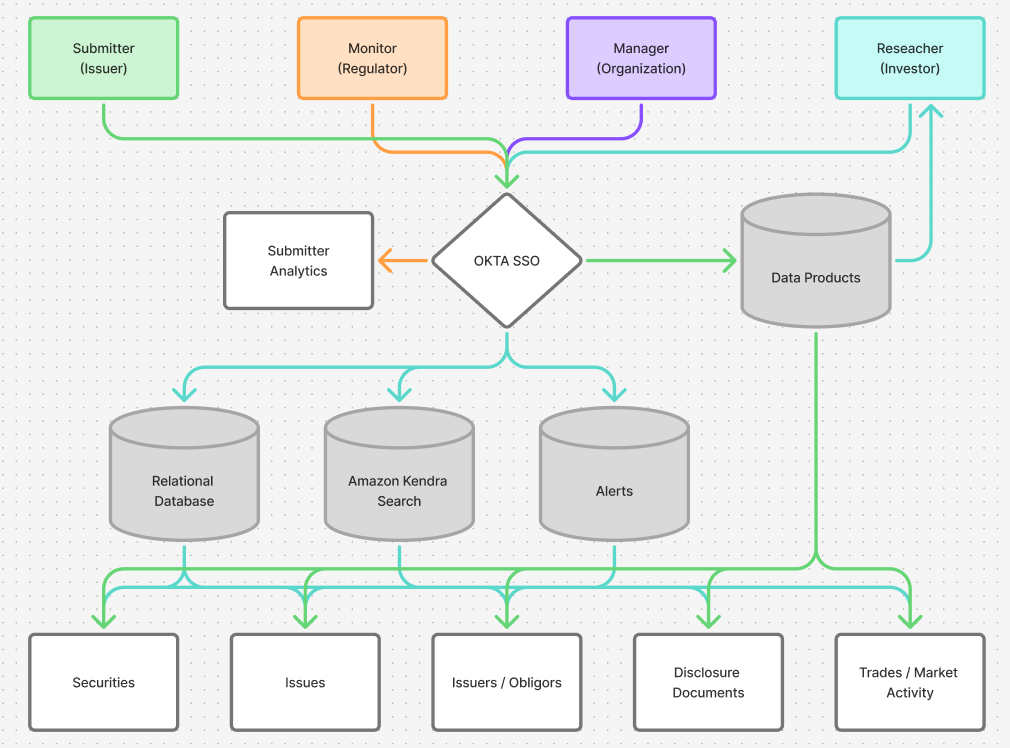
EMMA's complexity comes from more than its interface. Users interact with specialized financial information, different workflows, account states, permissions, and business rules, while the platform itself was undergoing significant technical change.
My role required moving between these layers rather than treating each interface as an isolated design problem.
Working with product owners, business analysts, domain experts, engineers, QA, and leadership, I contributed to understanding the relationships between:
User needs → Business requirements → Workflows → Information → Product experiences → Technical implementation
That understanding informed work across multiple areas of the modernization, including:
- Workflow design for specialized enterprise processes
- Information architecture and navigation
- Dashboards and data visualization
- Search and information discovery
- Authentication and account management
- Responsive platform experiences
- Design systems and reusable UI patterns
- Accessibility and UX quality
- UX measurement and governance
Rather than solving these areas independently, I looked for patterns and systems that could make the broader platform more understandable, consistent, and maintainable.
Designing the Future Platform
The modernization created opportunities to rethink how users interacted with major areas of EMMA rather than simply reproducing legacy interfaces.
My work spanned multiple product experiences, with particular focus on how information was structured, how users moved through complex workflows, and how the interface communicated system state and available actions.
Information Architecture & Navigation
Information architecture was an important part of the work, particularly where users needed to navigate complex financial information and understand relationships between related content.
This included work on:
- Platform navigation and information hierarchy
- Data-rich experiences and dashboards
- Search and filtering models
- Relationships between related financial information and documents
- Responsive information presentation
A significant example was the Data Hub, a separate initiative that emerged as leadership explored decoupling certain information and capabilities from the core EMMA Platform.
Rather than treating the Data Hub as simply another EMMA Platform redesign, I contributed to its information architecture, navigation, and dashboard concepts as the organization explored how this information could function as a more independent product experience.
Complex Product Experiences
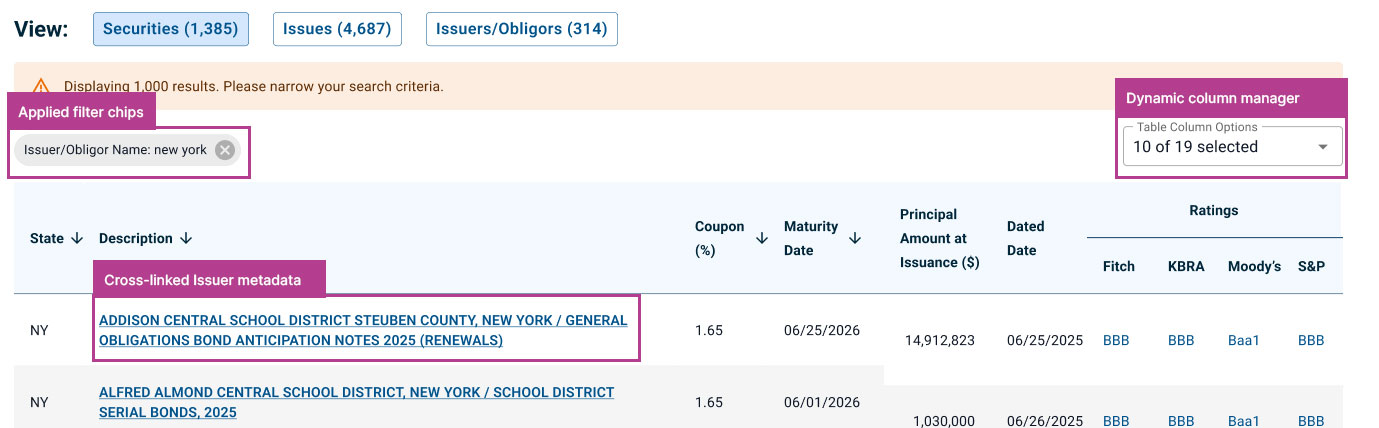
Across the modernization, I contributed to designs for:
- Homepage and platform navigation
- Dashboards and data visualization
- Advanced Search
- Authentication and account management
- Responsive experiences
- Specialized workflows and forms
The work varied by product area, but the underlying design challenge remained consistent: make complex enterprise capabilities understandable without hiding the information and functionality experienced users depend on.
For more specifics about updating design flows and complex data interaction, refer to Reimagining Advanced Search for a Complex Financial Data Platform.
Designing Around Complex Workflows & Technical Constraints
Modernizing EMMA required balancing user needs with business requirements, specialized domain rules, technical limitations, and the realities of an evolving platform.
Workflow Design
I evaluated and redesigned complex user flows across the platform, working with product, business analysts, subject matter experts, engineering, and QA to translate requirements and user needs into usable experiences.
The work involved making complex processes easier to understand while preserving the information, controls, and business rules users needed to complete specialized tasks.
Authentication & Account Management
Authentication and account management were also being modernized as part of the broader platform transformation.
I contributed to design and review of experiences associated with the transition to Okta-based authentication and account management, considering how authentication, account state, permissions, and user access affected the broader product experience.
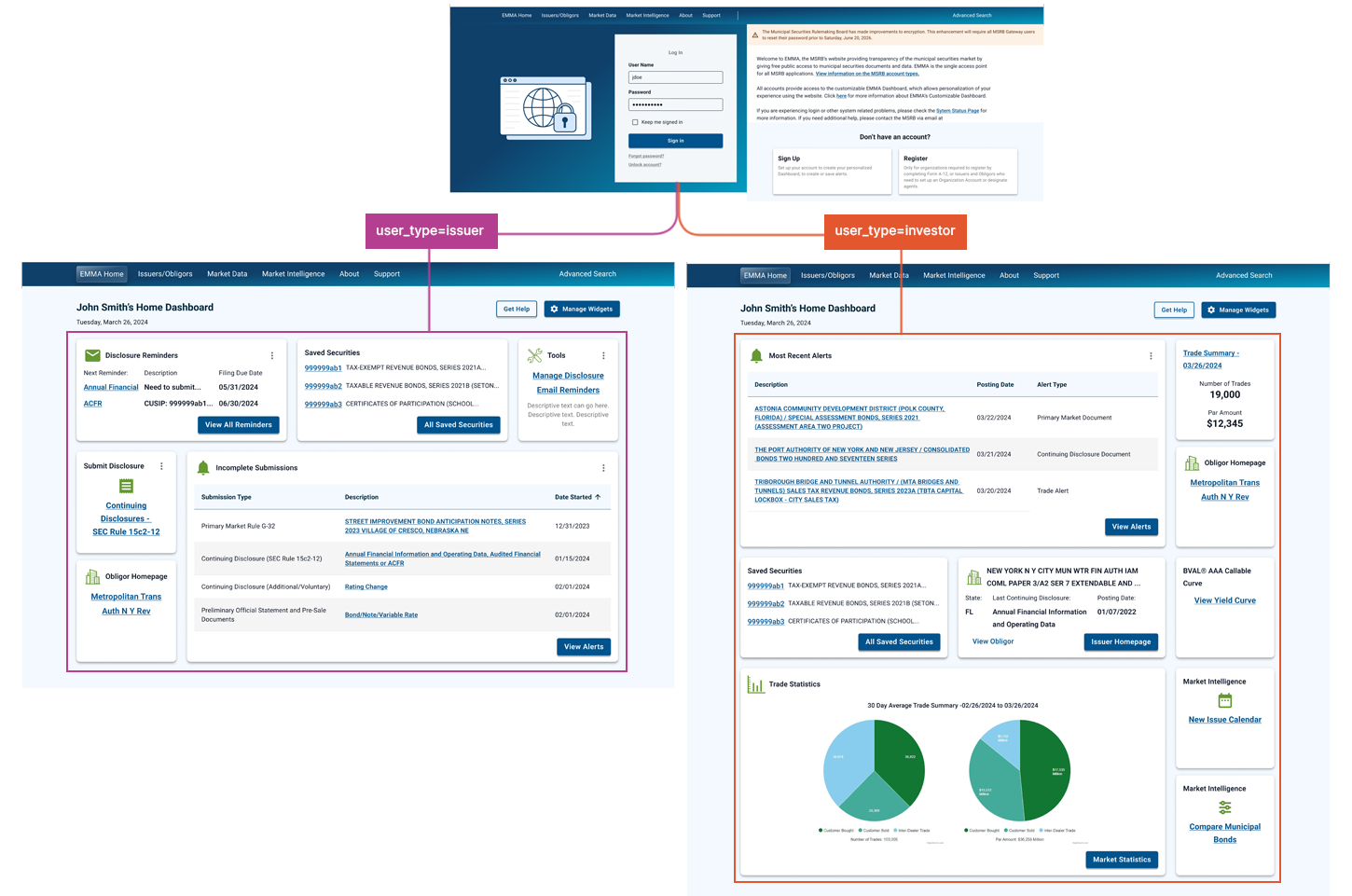
Dashboards & Data Experiences
I developed dashboard and data-visualization concepts across multiple product areas, focusing on information hierarchy, prioritization, and how users could quickly understand relevant information without navigating through unnecessary complexity.
Responsive Experiences
The modernization also created an opportunity to address experiences that had previously been designed primarily for fixed desktop layouts.
I extended key experiences into responsive layouts and considered how information hierarchy, controls, tables, and interaction patterns should adapt across screen sizes.
Designing With Engineering
Technical feasibility was a continuous part of the design process.
I worked closely with engineers to understand implementation constraints, translate design intent into workable solutions, and adapt designs as technical realities emerged.
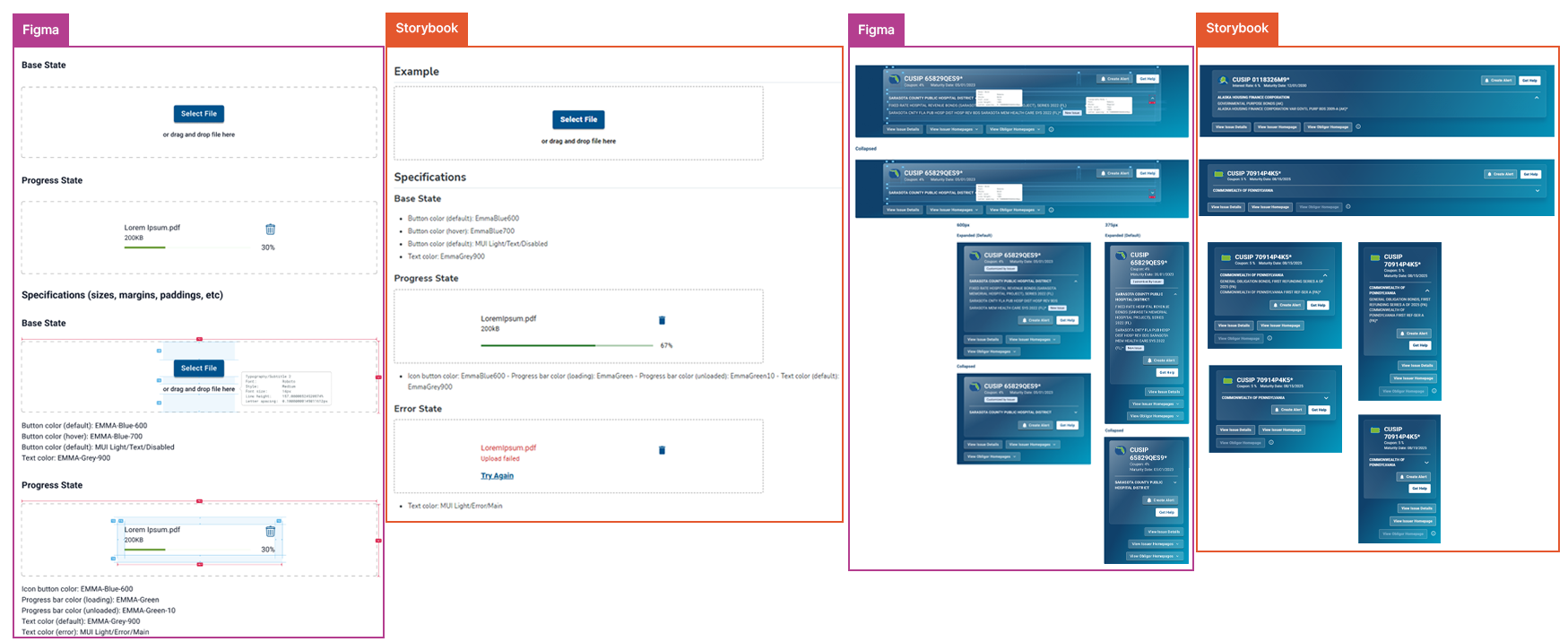
I also contributed directly to the codebase in React.js and helped document reusable components through Storybook, strengthening the connection between design specifications and implementation.
Cross-Functional Product Leadership
The scale and complexity of the modernization required UX to operate as a bridge between disciplines rather than as a downstream design function. I worked across Product, Engineering, Business Analysis, QA, subject matter experts, and leadership to help translate between different perspectives and constraints.
| Area | Summary | Contribution |
| Product & Business Alignment | 15+ initiatives across dashboards, search, authentication, workflows, and platform experiences | I worked with product owners and business stakeholders to clarify problems, requirements, priorities, and intended outcomes, helping turn complex business needs into actionable product experiences. |
| Engineering Collaboration | Technical Limits → React/Storybook Components | Design decisions were developed in close partnership with Engineering. I used technical conversations to understand constraints, identify implementation implications, and adjust solutions where necessary. This included contributing to the development codebase and creating Storybook documentation for reusable components, helping connect design-system decisions with their implementation. |
| Domain & Regulatory Alignment | Regulatory Mandates → Progressive UI Wizards | Working in a specialized financial-market environment required close collaboration with business analysts, subject matter experts, and stakeholders who understood the underlying business and regulatory requirements. My role was to translate that domain complexity into interfaces and workflows that remained understandable and usable without removing necessary complexity. |
| Executive Communication | Planned Enhancements → 9 Improvement KPIs | I communicated UX strategy and outcomes to executive leadership. Most notably, I developed and presented the organization's first repeatable UX measurement framework to executive stakeholders, translating detailed user and product signals into a structure leadership could use to evaluate modernization outcomes. |
Building the UX Systems Around the Product
As the modernization progressed, it became clear that redesigning individual experiences wasn't enough. The organization also needed systems that made quality UX easier to create, communicate, measure, and maintain.
I contributed to building those systems across several areas.
Design System
Established and documented 55+ EMMA-branded components based on MUI, creating reusable patterns across Figma and Storybook and providing guidance for designers and developers.
Accessibility & UX Quality
Helped embed accessibility and UX quality into delivery processes through reusable guidance and a WCAG 2.1 accessibility checklist incorporated into UI Jira work.
These practices were adopted across 3 product teams and 10+ roles, extending UX standards beyond individual design work.
UX Measurement
Created the organization's first repeatable UX measurement framework for the modernization, establishing a methodology for connecting research-derived problems to measurable outcomes and executive-level reporting.
The framework ultimately established 9 executive-level UX KPIs and provided a repeatable process for defining and measuring UX success.
Read more about how the framework was created in Building a Scalable UX Measurement System for Enterprise Modernization
UX Governance & Organizational Knowledge
Developed documentation, terminology, templates, onboarding resources, and governance practices that reduced reliance on individual knowledge and created more consistent ways for teams to work with UX.
Together, these systems helped move UX from a collection of individual project activities toward a more scalable organizational capability.
Impact
The modernization provided the context for a broad body of UX work spanning product experiences and organizational systems.
| Area | Contribution |
| Product Experience | 15+ initiatives across dashboards, search, authentication, workflows, and platform experiences |
| Information Architecture | Navigation, information hierarchy, search, and Data Hub IA concepts for complex financial information |
| Design System | 55+ documented EMMA-branded components based on MUI |
| Accessibility & UX Quality | Reusable UX/accessibility guidance adopted across 3 product teams and 10+ roles |
| Measurement | Repeatable UX measurement framework with 9 executive-level KPIs |
| UX Operations | Documentation, governance, terminology, onboarding, and reusable UX processes |
| Implementation | Direct contribution to the React.js codebase and Storybook component documentation |
Scale of the Work
$6MMulti-year platform modernization
2.1MActive users impacted in 2025
15+Product initiatives
55+EMMA-branded reusable components
3 teams / 10+ rolesAdoption of UX and accessibility standards
9Executive-level UX KPIs
Strategic Reflection
Enterprise modernization is fundamentally a systems problem.
Replacing aging technology and redesigning interfaces can improve individual experiences, but sustainable product quality also depends on the systems surrounding the product: how teams understand users, make decisions, implement designs, measure outcomes, and preserve organizational knowledge.
My most impactful contributions came from working across those layers.
Whether I was restructuring a complex workflow, developing a dashboard, contributing to the codebase, establishing reusable components, defining UX metrics, or creating governance practices, the underlying goal was the same:
Make complex systems easier for both users and the organization to navigate.
That became the larger role of UX within the modernization—not simply designing the new EMMA, but helping establish the product and organizational systems needed to support it.
Next case study: Building a Scalable UX Measurement System for Enterprise Modernization