Product
The Electronic Municipal Market Access (EMMA) is the Municipal Securities Rulemaking Board’s (MSRB) main web product which allows for analysis of user-submitted information regarding municipal securities. It hosts a wide range of content including borrower and loan details, financial and event documents related to loans, and market analysis tools such as yield curves, market statistics, and new issue calendars.
The MSRB is the principal financial regulator over the municipal bond market and those working within it. Created by congressional mandate in 1975, its goal is to protect investors, issuers and the public interest by promoting a fair and efficient market.
Problem
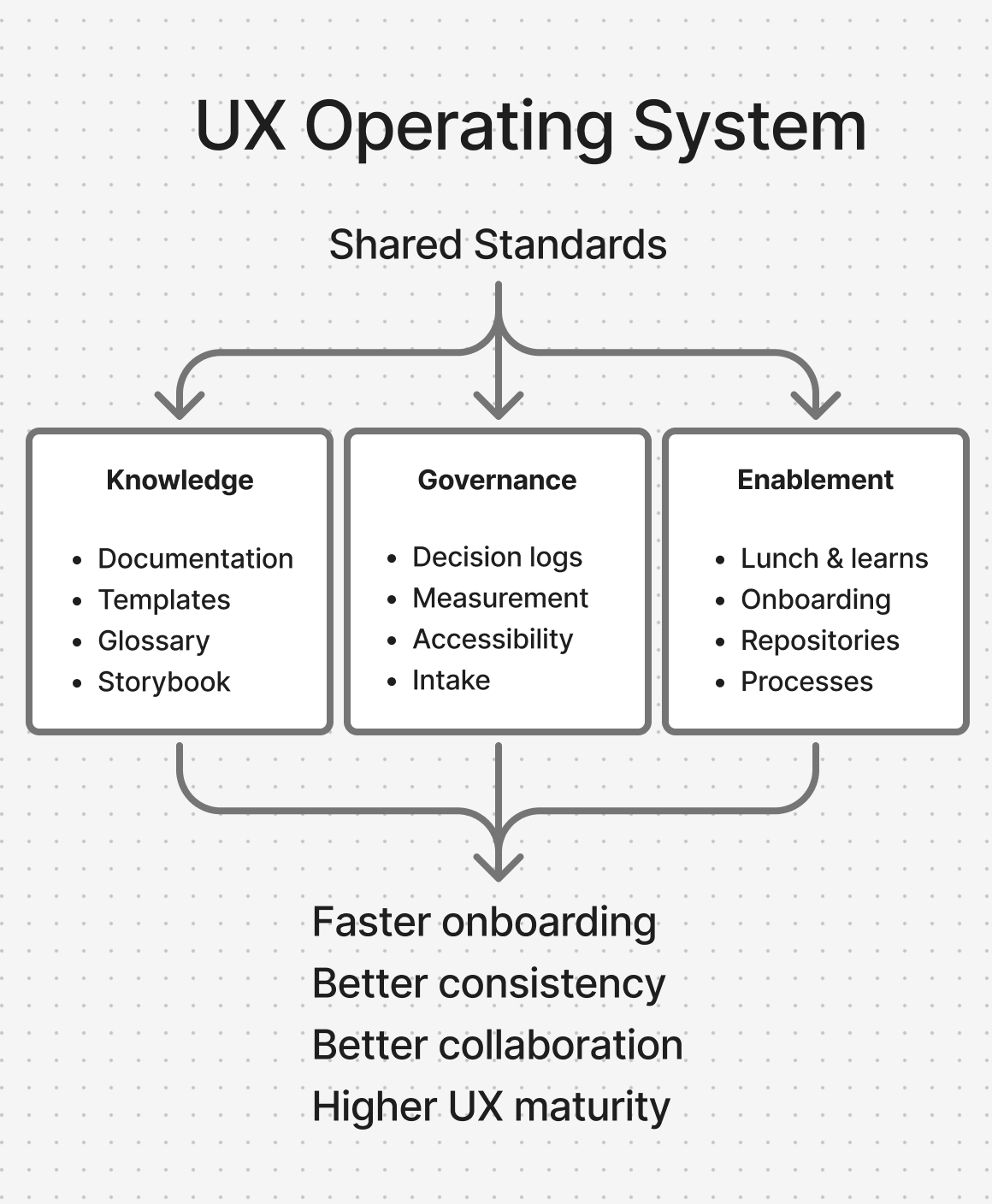
When I joined the MSRB, UX practices relied heavily on individual knowledge and informal communication.
As the organization shifted from project-based work to product-based teams, this created increasing challenges:
- inconsistent documentation
- duplicated effort
- design decisions lost over time
- limited reuse between initiatives
- no shared source of truth
Rather than solving each problem independently, I focused on creating systems that made high-quality UX work easier to repeat. The goal was not to add process overhead, but to create lightweight structures that allowed teams to move faster with greater confidence.
Strategy
Rather than solving documentation, governance, onboarding, and collaboration as independent problems, I designed a UX operating model—a collection of standards, processes, and shared knowledge that made high-quality UX work easier to repeat across teams.
Tranformation
| Before | After |
|---|---|
| Critical knowledge lived in people's heads. | Knowledge became reusable organizational assets. |
| Design decisions disappeared after projects ended. | Decision history became reusable documentation. |
| Every project reinvented design and UX process. | Teams started from established standards. |
| Onboarding depended on coworkers. | New team members could self-serve. |
Building Shared Standards
As EMMA's component library matured, I recognized that the technical implementation alone wasn't enough to ensure consistency. Although a branded component library had been established using 55+ MUI-based components, there was limited guidance explaining when to use them, how they should be implemented, or where designers and developers could find supporting information.
I transformed the component library from a reusable codebase into a shared product language by documenting design intent, implementation guidance, and usage standards for both designers and engineers.
The resulting documentation system included:
- Component implementation guidance covering imports, usage patterns, and design intent.
- Design standards describing branding, interaction patterns, and visual consistency.
- Repository and onboarding documentation that supported faster ramp-up for new contributors.
- Matching guidance within Figma component libraries so designers and developers referenced the same standards throughout the design and implementation process.
Embedding Accessibility into Delivery
To make accessibility part of everyday delivery rather than a final review, I partnered with QA to embed a reusable WCAG 2.1 checklist into every UI Jira story. This integrated accessibility expectations directly into the delivery process, helping teams evaluate compliance consistently throughout implementation instead of treating accessibility as a final verification step.
Creating Organizational Knowledge Systems
As the modernization effort expanded across multiple product teams and disciplines, institutional knowledge became increasingly fragmented. Research findings, legacy system understanding, permissions documentation, and project artifacts were scattered across multiple locations or depended on individual team members to explain their context.
Rather than treating repositories as storage locations, I approached them as information architecture problems.
To reduce reliance on undocumented context, I helped establish a shared knowledge catalog that made critical product information easier to discover, understand, and reuse throughout the product lifecycle. This reduced time spent searching for resources and made onboarding easier for new team members.
The knowledge base was intentionally structured with multiple entry points—from high-level business concepts to technical implementation details—so employees with different roles and levels of experience could quickly find the information they needed.
Establishing a Shared Language
One of the earliest organizational challenges I identified wasn't technical—it was linguistic. The same concepts were often referred to by multiple names, sometimes even within the same department. This created confusion during onboarding, slowed cross-functional collaboration, and made documentation difficult to trust.
Working across seven departments and with more than ten subject matter experts, I helped establish a shared terminology and taxonomy so everyone was working from the same definitions. The shared reference documentation established consistent definitions for:
- Core system objects and their business purpose
- Relationships between objects, including creation rules and organizational hierarchy
- Calls to action, including interaction patterns and expected behaviors
- User roles and permissions, documenting workflows, visibility, and access rules
Establishing UX Governance and Decision Practices
As UX became more deeply integrated into the organization's product development process, I focused on creating governance structures that reduced ambiguity and ensured knowledge, standards, and decisions could scale beyond individual contributors.
I established governance practices across four areas where UX decisions previously depended heavily on individual context and allowed teams to:
Define success consistently
The UX measurement framework became one mechanism for connecting product decisions to measurable user outcomes. By translating research findings into goals, signals, and metrics, product owners could evaluate feature decisions not only through delivery milestones but through the user problems they were intended to solve.
Preserve design decision rationale
Documenting the rationale behind major UX recommendations, measurement strategies, and information architecture decisions so future teams understood not only what had been decided, but why. Further, I created an automation workflow that monitored incoming requests and surfaced potential UX impacts within Microsoft Teams, allowing teams to identify design considerations earlier in the intake process.
Build quality into delivery
Embedding UX activities—including accessibility validation, measurement planning, and documentation—into the product delivery lifecycle so quality became part of the process rather than a final review step.
Preserve organizational knowledge
I established shared implementation guidance through Storybook documentation, component standards, accessibility expectations, and design references that aligned designers and developers around consistent patterns.
Facilitating Cross-functional Tradeoffs
Modernization required balancing user needs, regulatory requirements, technical constraints, and business priorities. I frequently served as the bridge between disciplines, translating complex domain requirements into workflows and implementation guidance that product, engineering, and business teams could evaluate together. Through design reviews, documentation, accessibility guidance, and implementation discussions, I reduced ambiguity and helped teams resolve tradeoffs earlier in the delivery process.
Building Organizational UX Capability
As UX practices became more integrated into the modernization effort, I recognized that long-term success depended on more than creating documentation and standards. My focus shifted from delivering UX outputs directly to increasing the organization's ability to apply UX practices consistently.
I focused on creating reusable resources and learning opportunities that allowed product, engineering, and business teams to better understand UX practices, leverage available resources, and incorporate user-centered thinking into their own workflows.
Making Expertise Transferable
Rather than relying on one-on-one knowledge transfer, I created reusable documentation, templates, and reference materials that allowed teams to access guidance when they needed it.
Examples included:
- Design decision record formats
- UX Measurement framework documentation
- Accessibility resources
These resources made expertise transferable and created a more consistent foundation for future work.
Expanding Organizational Understanding of UX Measurement
After developing the UX measurement framework, I presented the methodology and findings to executive stakeholders, including the Chief Product Officer. Due to broader interest in the possibilities of UX analytics, I was asked to deliver a company-wide Lunch & Learn focused on how UX metrics could support better decision-making.
The session expanded organizational awareness of what could be measured beyond basic analytics reporting. The session generated enough organizational interest that project management incorporated success metric identification into initiative intake, ensuring measurable outcomes were considered during planning rather than after implementation.
Supporting New Team Members and Contributors
As teams expanded to include new product owners, contractors, and cross-functional contributors, I helped create onboarding resources that reduced the amount of context required to become effective.
By documenting systems, terminology, processes, and expectations, new contributors could understand not only what work was being done, but why decisions had been made and how their work connected to broader product goals.
Collectively, these initiatives transformed UX from an individual design practice into an organizational capability. Rather than depending on individual expertise, teams could build from shared standards, documented decisions, reusable knowledge, and repeatable processes. The result was greater consistency, faster onboarding, stronger cross-functional alignment, and a foundation that allowed UX practices to continue scaling as the organization evolved.
Next case study: Validating Alert Flows